Wednesday, October 28, 2020

BEST INSTAGRAM CAPTIONS – THE INSTAGRAM CAPTIONS OF 2020

Just like Facebook posts, adding captions to your Instagram posts tend to engage your audience more. It helps your followers to see how you want them to interpret the images you post. Capturing the essence of an Instagram post in words is the idea behind captions. Creative captions can blow your audience away and encourage follower participation.

The biggest Instagram stars use captions that are inclusive of all audiences, thus using words that resonate with the followers is the way to go. Captions give your readers insight into your emotions when you post.

The following are the best Instagram captions you can adopt. They have been grouped under sassy, feel-good, cute, funny, and clever captions.

BEST INSTAGRAM CAPTIONS - THE INSTAGRAM CAPTIONS OF 2020

SASSY CAPTIONS

These are captions with a little bit of sass. A little funny sarcasm can get your audience engaged. Examples are:

  • Bow down to the queen
  • Also, Are you a software update? Because NOT NOW
  • Do not try me, i am not a sample

FEEL GOOD CAPTIONS

A good quote that captures the joy you felt when sharing a post can be contagious, even inspiring to your followers. Such quotes and captions include

  • When you can’t find it, be the Sunshine
  • Happiest people make the best of everything
  • There’s good in every day
  • Be the change
  • Today’s is the best day

CUTE CAPTIONS

Cute captions are perfect for those adorable pics and videos. This could be a beautiful and serene environment, a playful pup, a cute baby, and so on. A follower will find it hard not to tap the like button in a post that makes them go “Aww!”. Cute Instagram captions include

  • So adorable, without even trying to
  • Seven billion smiles and yours is my favorite
  • Don’t grow up… it’s a trap
  • I know how to purr my way out of everything

Funny Captions

Captions that make your followers laugh are very captivating and engaging. A little humor goes a long way. It can also be great for a change especially for a platform that seems overused for vanity and perfection. These include

  • Firstly, Handle every situation like a dog. If you can’t eat it or play with it, just pee on it and walk away
  • Also, I am not lazy. I am in an energy-saving mood
  • I was going to take over the world this morning, but i overslept. Postponed. Again.
  • I never make the same mistakes twice. I make it like five or six times, you know, just to be sure
  • In addition, Sleep like no one’s watching

CLEVER CAPTIONS

A stunning photo of a natural landscape will go well with an apt quote. Your followers will appreciate the “funny” wisdom you are sharing with them. This engages their thoughts. These include

  • The idea is to die young… as late as possible
  • A soft heart in a cruel world is courage
  • Being afraid of things going wrong isn’t the way to make them go right
  • When nothing goes right, go left


from WordPress https://ift.tt/31MwJQ4

POLL ON INSTAGRAM – HOW TO MAKE A POLL ON INSTAGRAM

POLL ON INSTAGRAM are a great way to get your audience or followers to engage you on Instagram. The obvious ways to make interactions on the Instagram platform are comments, likes, direct messaging, and stories being shared amongst users. Making Instagram polls is also an effective way to get followers to engage. It is also a potentially fun way to interact.

Polls properly handled can give you information on the type of content your followers want to see more and the same with the kind of live videos and stories they are eager to engage.

Polls can be created in one of your stories or in a direct message and it can be only be created on the Instagram app.

INSTAGRAM POLLS - HOW TO MAKE A POLL ON INSTAGRAM

MAKING A POLL ON INSTAGRAM STORIES

Instagram stories are short videos or photos that a person can use to share what he is doing at the moment with his followers. Making a poll on Instagram entails:

  1. Firstly, Open the Instagram app on your iOS or Android device and sign in to your account or switch to the account you use
  2. Secondly, Tap your Story profile picture bubble at the top of the home feed or swipe right on the screen from the home feed to access the story camera tab
  3. Thirdly, Record a video, or take a photo to create your story. Use stickers, filters, and other editing effects to customize your story exactly the way you want
  4. From the story preview tab, tap the sticker button at the top of the screen
  5. Tap the Poll sticker
  6. Lastly, Type a question you want to ask your audience or followers in the Ask a question field.

Poll’s default answers are a yes or no type. Questions that involve customizing two different answers (like today/tomorrow, on/off, black/white) and others can also be asked.

  1. Tap the YES button to customize your two poll answers
  2. Tap Done
  3. Tap your Story in the bottom left of the screen to post it to your stories. You can tap Close Friends to share it only with those chosen as closest friends.

HOW TO MAKE A POLL IN INSTAGRAM DIRECT MESSAGES

  1. Tap the messages button in the top right corner of the home feed
  2. Secondly, Tap the Plus sign in the top right corner to start a new message. Or tap an existing message to continue a conversation
  3. Thirdly, Tap the blue camera in the message field
  4. Take a photo or record a video. You can customize your photo or video using filters or stickers
  5. Tap the Poll Sticker
  6. Type a question you want to ask your audience
  7. Tap Done
  8. Tap VIEW ONCE if you do not want the direct messages to be replayed by default and tap KEEP IN CHAT if you want to keep the message on the chat indefinitely
  9. Lastly, Tap the friend of friends profile bubble to send to friends or tap send to others and select people from the list to send it to them.


from WordPress https://ift.tt/3oCypFN

Moody’s Corporation – Understanding Moody’s Financial Services

What is Moody’s?

Moody’s corporation, otherwise known as Moody’s, is an American business and financial services company. It is the holding company that owns both Moody’s Investors Service, which rates fixed-income debt securities, as well as Moody’s Analytics, which offers software and research services.

It was founded in 1909 by John Moody to produce manuals of statistics related to stocks and bonds and bond ratings. In 1962, Moody’s was acquired by Dun & Bradstreet. In 2000, Moody’s Corporation was spun off by Dun &Bradstreet as a separate company that was listed on the NYSE under MCO. Then in 2007, Moody’s Corporation was split into two divisions. They are Moody’s Investors Service, the rating agency, and Moody’s Analytics, with all of its other products.

Moody’s Corporation - Understanding Moody’s Financial Services

Understanding Moody’s

Moody’s assigns ratings to bonds, stock, and state entities, and investors pay close attention to these ratings. Moody’s ratings range from AAA, which is the highest grade. For the top quality issuer with the lowest risk.  Down to C, which is mostly given to securities that are in default. With little chance for recovery of principal or interest.

History of Moody’s

Moody’s history dates back to two publishing companies. Established by John Moody, the inventor of modern bond credit ratings. It was first published in 1900 by John Moody.  Nine years before he founded Moody’s Corporation. Known initially as Moody’s Manual of Industrial and Securities. It became Moody’s Manual of Railroads and Corporation Securities. Then by Moody’s Analyses of Investments.

Moody published his first market assessment in 1900, known as Moody’s Manual of Industrial and Miscellaneous Securities, and established John Moody & Company. The publication offered statistics that relate to stocks and bonds of state agencies, mining, utilities, and food companies. The publication saw early success and sold out its first print run in its first two months.

Moody’s Manual became a  known work by 1903. However, the 1907 money crisis brought several changes in the market, esp the creation of the Federal Reserve System. Thus Moody was forced to sell his business, because of a shortage of capital. In 1909, Moody returned with a new work solely focused on railroad bonds, Analysis of Railroad Investments, and a new company, Moody’s Analyses Publishing Company.

By 1962, Moody’s Investors Service was bought by Dun & Bradstreet. This is a firm engaged in the related field of credit reporting, even though they continue to operate largely as separate companies. Moody’s superior outcome by the late 1990s compared to its parent company brought investor pressure to separate the outfits. Dun & Bradstreet in December 1999 announced it would spin off Moody’s Investors Service into a separate publicly-traded company. On September 30, 2000, the spin-off was ended.

Moody’s Ratings

Ever since John Moody devised the first bond ratings more than a century ago, Moody’s rating systems have greatly evolved. The corporation’s rating system has evolved in response to the high depth and breadth of the global capital markets. Much of the work in Moody’s rating system, is a result of a change to market needs for clarity around the issues of credit risk. It may also be a response to demands for finer distinctions in rating. Thus Moody’s Rating Symbols and are timely updated.


from WordPress https://ift.tt/3e1APc4

Adverse Credit History – How Does Adverse Credit History Affect You?

Most people use the term adverse credit history and you wonder what it means. It simply means someone has a poor or bad credit history. The term therefore is used to describe people who may have struggled to manage credit in the past.

What is Adverse Credit History?

Is a term lenders use to define and classify consumers who have less-than-stellar credit histories when being considered for a loan or credit. This may include late payments of 90 days or more, deficiency judgment, garnishment orders, repossessions, bankruptcy, foreclosures, tax liens, and/or debt write-offs.

Adverse Credit History - How Does Adverse Credit History Affect You?

How Does Adverse History Affect You?

When you apply for credit, the lender checks your credit history. Where you have a good credit history and meet other criteria, the lender will be happy to extend credit to you. However, if your credit history is poor, some lenders may decide not to lend to you, or offer you a product that has a less interest rate. When this happens, it is known as “adverse credit”.

What is Your Credit History?

It is very important to understand the state of your credit history. This is because, every time you take out a credit product, like a loan, mortgage, credit card, or mobile phone contract, it is being told to three credit reference agencies which are Experian, Equifax, and TransUnion.

Each month, your lenders report to the agencies how you have made your payments in full and on time. This data is held by the credit reference agencies for six years.

Adverse Credit History – Lenders & Borrowers

When it comes to creditors and lenders, they care about the adverse credit history of a borrower. This is because if a borrower has had credit issues in the past.  They are more likely to repeat the same in the future. Thus, lenders may not want to extend credit. Or may only be willing to lend money at a higher interest rate. Than what they charge their lowest risk customers with no A.C.H.

Borrowers, on the other hand, can find out if they have an adverse credit history. By getting a free credit report from each of the three major credit bureaus. Which are Experian, Equifax, and TransUnion. Credit card companies also give customers the option of obtaining a monthly credit score update via their services. With the report having no effect on a credit score through a soft inquiry.

Where it concerns student loans. Adverse credit history has a very specific meaning. It implies that a borrower has 90-day delinquency on any debt. Or that they have experienced a specific adverse credit event within the last five years like bankruptcy, repossession, or tax lien. Adverse credit history makes a borrower ineligible for a federal PLUS loan.

In conclusion, borrowers are likely to find it more difficult to obtain credit and may have to pay higher interest rates on loans or require subprime lending.


from WordPress https://ift.tt/3oDQoM6

What is the Equal Credit Opportunity Act And Requirements

What is the Equal Credit Opportunity Act?

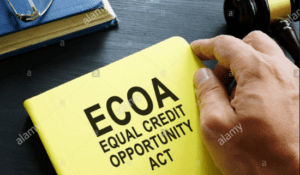
 Equal credit opportunity act (ECOA), is an act that requires banks, credit card companies, and anyone else involved in lending to make credit equally available to all creditworthy customers.

ECOA prohibits credit discrimination on the basis of race, color, national origin, sex, marital status, age, or as a result of a person receiving public assistance in whole or in part. It also prohibits action against anyone who has exercised any rights under the Consumer Credit Protection Act.

What is the Equal Credit Opportunity Act And Requirements

It further states that when determining a consumer’s creditworthiness, financial institutions instead consider the following: income, expenses, debts, and credit history. ECOA permits creditors to ask for certain information to help in the documentation process. But even that is limited by certain rules.

This Act applies not just when credit is denied, but also applies if a consumer gets less favorable borrowing terms like a higher interest rate. ECOA shields borrowers in activities before, during, and after the extension of credit.

When Was ECOA Passed?

ECOA was passed in 1974 by the house of Representatives by a vote of 282-94. It then moved to the Senate, which passed an amended version 89-0. Thereafter, the House approved the amended version 355-1 and the bill was signed into law by President Gerald Ford on Oct 10, 1974.

Formerly, the Federal Reserve Board was in charge. However, that role was transferred to the Consumer Financial Protection Bureau, which was created in 2011 as part of the Dodd-Frank Act.

However, that piece of legislation has been rolled back in 2018 after Donald Trump promised to “do a number on Dodd-Frank”. Congress accepted and passed the Economic Growth, Regulatory Relief, and Consumer Protection Act on May 22, 2018.

This dealt largely with banking regulations, though, and the proponent is of the opinion that it should not adversely impact the agency’s role when it comes to ECOA guidelines.

Equal Credit Opportunity Act (ECOA) Requirements

ECOA states that creditors are to:

  • Offer the applicant a note of action. Taken within 30 calendar days of receiving the application. Except certain exception applies. Note, that these notes of action taken are sometimes to be in writing. While in other cases, oral notification satisfies the requirement.
  • Creditors are to offer specific reason(s). Or allow the candidate to know how to get the reason(s) why they are denied credit. Or granted credit in a way that differs from the terms under which they originally applied. Also, the same rule applies in a situation where a creditor closes the account. Also when a creditor refuses to increase a line of credit. It makes a negative change in the terms of the credit. And does not make the same change for other consumers. Where the creditor refuses to give credit at the same. Or approximately the same, terms as were offered when the credit was initially applied for.

Equal Credit Opportunity Act (ECOA) Penalties

Organizations who are discovered to have violated the ECOA could potentially face class-action lawsuits by the Department of Justice (DOJ). This lawsuit will be carried if the DOJ or any affiliate agencies recognize a pattern of discrimination.

On the other hand, the Consumer Financial Protection Bureau (CFPB) seeks to enforce ECOA with other federal agencies, like the Federal Reserve Board, the Federal Deposit Insurance Corporation (FDIC), and the National Credit Union Administration (NCUA). If any organization is found guilty, they may have to pay out punitive damages which can be significant, and cover any costs incurred by the person who is wronged.

ECOA was passed to protect women and minorities from being discriminated against by credit card companies.


from WordPress https://ift.tt/3mwqJTG

Student Loan Interest Deduction—How The Loan Interest Deduction Works

Student Loan Interest Deduction is needed to reduce the cost of borrowing for higher education. What do I mean? Taxpayers will deduct the interest of $2,500 which is paid on a student loan from your taxable income. In fact, it is a strategy that parents can use to pay for higher education.

Likewise, now that interest on student loans from federal agencies has been suspended during the Coronavirus crisis by President Trump on March 13, 2020, but this does not affect private student loans. In this case, thus, a private loan may not have interest payment to deduct since there is suspension still holds.

Student Loan Interest Deduction—How The Loan Interest Deduction Works

Things you can enjoy with student loan interest deduction

  • You can deduct up to $2,500 of interest you paid on a loan for higher education.
  • Thus, if you must be eligible, your income should be within certain limits.
  • Do you know that interest on student loans from federal agencies has been suspended? Therefore, federal loans may not have the interest to deduct.

How a student loan interest Deduction Works

Student deduction will make a shift to your income on the internal Revenue Service (IRS) Form 1040. In fact, it may reduce the taxes you owe or increase the tax refund you will receive.

To qualify, the student loan should at least have been taken out from the taxpayer, or from their dependents. In other words, if the student is not the base person, then a parent cannot claim the deduction even if they help in repaying the loan.

In addition, loans should as well be taken out for at least an academic period in which the student is enrolled at least half-time in a program. Rather, a one that can grant you a degree, certificate, or valuable credential. In summary, this qualified higher education expenses like tuition, room, and board, insurance and health fee, textbooks, etc.

Again, The student’s school must be among the eligible institution.


from WordPress https://ift.tt/3oyKwDv

Student Loans – Is Student Loan Debt The Next Financial Crisis?

We must not forget what we call “The Great Recession when we hear of the financial crisis. It is not just loan debt accumulated by student loans. That is to say, other loan debt can cause a financial crisis. Because of the mortgage crisis of 2008, many believe that student loan debt is the next financial crisis. Thus, this will be proven below if it is true or not.

Student Loans - Is Student Loan Debt The Next Financial Crisis?

Cause and effect

Young people follow the path of college education because they have heard of the much success achieved with a college education. Thus, education is a key to success.

Today, student loans could be the best alternative to pay off college education, and if you must be successful, thus, you must study.

Is the student loan debt loan the next financial crisis? Therefore, according to the project on Student Debt, the average student loan debt for college students was $25, 250 in 2010.  Thus, it is 5% higher than the previous year. This also means that the total student-loan borrowing for one year is more than $100 billion marks, and when combined, with the outstanding debt, it is more than $1 trillion.

After seeing this, why won’t I believe that student loan debt could be the next financial crisis?  OF course, it is totally clear to me. What do you think?

In addition, Tuition has risen at a range of 6 to 9% yearly and sometimes twice the normal rate for the past 45 years and above. That is to say, demand for larger student loans will increase as well. As a result, college becomes more demanding to be reached, while the economy goes down without producing more graduates. Moreover, it is clear that many will not be able to pay for these loans when their tuition is very high.

Bankruptcy is a situation that brings companies down. But, according to laws, you cannot escape from completing your loan debt. Thus, loan debt cannot be written off by bankruptcy. So, even in a bad financial situation, graduates will still pay on their student loan debt till it is off.

Solution

The idea of Bankruptcy attorneys is a suggestion that can be the only way to solve the problem of student loan debt. Guess what? It says “If only the student loan debt is to be discharged just as credit card or other debt, things will move. Another says “College tuition fluctuation should be regulated.

In conclusion, in Inspite of that student debt loan is 1 trillion; yet, it is not up to mortgage debt, that is, $13 trillion. Therefore, many consider it that it wouldn’t cause a crisis. Thus, it still requires more attention before it gets out of control.


from WordPress https://ift.tt/3oJX5fA